You may notice some format changes. Its the result of blogger crapping out when I was making a minor change to the template. I was left with no template and the backup was not too useful.
The book seems to be getting a lot of press, which is nice. Emily Gertz wrote a nice story about my time in Iraq and my ongoing interest in the region. The story is running in the current edition of Grist Magazine. I was interviewed today by the Baltimore Sun. On Saturday I am scheduled to be on CNN around 12:30.
I was very excited to see that google has a new Arabic/English translation program in Beta. The one I've used before was somewhat limited. Like the other translation programs that Google has, it will do a machine translation of a website on the fly. Depending on the language, you can often get a passable translation. I tried it on this site as well as the Iraq Fauna Wiki. I'm planning to use it to create an Arabic mirror. Like all Machine Translations the result will need work, but its a start. If nothing else it could produce some amusing reading for Arabic speakers. Currently it seems to work best for news and would not be recommended for poetry.
Friday, April 28, 2006
Iraq Fauna Wiki and Fly Fishing in Iraq
 I thought I'd elaborate a bit more on the new site I recently set up called Iraq Fauna. Its a wiki format, so like wikipedia where anyone can edit the entries this new site is meant to develop as an aggregation of information and ideas about animal life and the environment in Iraq. Please email me if you have any trouble using the site. To edit a page all you need to do is press the edit button and start typing. Don't worry about screwing anything up, all previous versions are saved and can be recovered.
I'd like to emphasize the collaborative part of this, and invite everyone to contribute to the extent they can, even if it is reformatting the text on a page. I think, relatively rapidly we can build a site that can be a valuable resource. For those who have been in Iraq or are currently in the country please add your observations and photos. I'll be adding all my wildlife and habitat photos to the gallery.
I've set up the skeleton of the site and I'm currently working on. I also have put up a list for the Birds of Iraq, which is a starting point for developing a definitive list based on well documented sightings and specimen records. I'm hoping to have a significant amount of Arabic language content and welcome anyone who wants to start working on it. I'll be adding Arabic names on the Checklist of the Birds of Iraq page.
On another note I found a great website written by Joel, a US Navy officer, devoted to fishing in the lakes around the Camp Victory Complex near Baghdad International Airport. This guy even started a Fly Fishing Course for military personnel! Also some nice fish pictures.
 I thought I'd elaborate a bit more on the new site I recently set up called Iraq Fauna. Its a wiki format, so like wikipedia where anyone can edit the entries this new site is meant to develop as an aggregation of information and ideas about animal life and the environment in Iraq. Please email me if you have any trouble using the site. To edit a page all you need to do is press the edit button and start typing. Don't worry about screwing anything up, all previous versions are saved and can be recovered.
I'd like to emphasize the collaborative part of this, and invite everyone to contribute to the extent they can, even if it is reformatting the text on a page. I think, relatively rapidly we can build a site that can be a valuable resource. For those who have been in Iraq or are currently in the country please add your observations and photos. I'll be adding all my wildlife and habitat photos to the gallery.
I've set up the skeleton of the site and I'm currently working on. I also have put up a list for the Birds of Iraq, which is a starting point for developing a definitive list based on well documented sightings and specimen records. I'm hoping to have a significant amount of Arabic language content and welcome anyone who wants to start working on it. I'll be adding Arabic names on the Checklist of the Birds of Iraq page.
On another note I found a great website written by Joel, a US Navy officer, devoted to fishing in the lakes around the Camp Victory Complex near Baghdad International Airport. This guy even started a Fly Fishing Course for military personnel! Also some nice fish pictures.
Thursday, April 20, 2006
Environmental NGOs in Iraq


Nature Iraq has it's latest newsletter up on the Eden Again Website. Many positive developments are reported including the release of an Interim master plan for restoration and management of the southern marshes by the New Eden Group (A collaboration of Nature Iraq and the Italian Ministry of Environment and Territory). This document is the culmination of years of work studying every salient aspect of the marshes from Biodiversity to Hydrology and Economic impacts. The document will be presented to the Iraqi government to inform future decisions on the marshes. As the management and responsibility for the marshes and water resources transition to the Iraqi government there is a need to keep the benefits of marsh restoration in the forefront.
Also reported was an Regional Environmental Roundtable which brought together NGOs from Iraq, Syria, Jordan and Lebanon in September. They discussed the need for training in a number of areas to build their capacity to carry out their respective projects. This is where I think more International Environmental Groups and Educational Institutions can have a real positive impact. I perceive some prominent groups only want to support development in Iraq in the theoretical, not practical sense. Perhaps there is an attitude that participating in Iraq would somehow add legitimacy to the military/political conflict which they opposed so strenuously. If this is true, it is morally bankrupt thinking. Making positive change and building civil society should take primacy over political posturing. I encourage both individuals and organizations to contribute as they can. Iraq Nature counts 35 environmental NGOs in Iraq!
The areas of need are:
1. Strategic Planning
2. Administrative and Management Skills
3. Capacity building for environmental impact assessments/evaluations
4. Advocacy Skills
Ideally, training should happen locally, since it allows the greatest number of people to participate. Several workshops have been held regionally, such as in Jordan or Syria.
Finally a field report from the Canada-Iraq Marshland Initiative is written up in the Nature Iraq Newsletter. Ecological surveys of major reflooded areas have been conducted by 6 teams, comprising 44 students and technical advisors from Central and Southern Iraq. Major groups surveyed include phytoplankton, zooplankton, benthic invertebrates, plants, fish and birds. Early indications are that some reflooded areas are showing signs of full recovery. Nearly all the rare and endangered birds have been found and some have been found breeding. I've heard through other channels that African Darter, Sacred Ibis, Goliath Heron and Basra Reed Warbler have all been seen.
I put up a new page on the Iraq Fauna Wiki to brainstorm on ideas to support Iraqi organizations working on environmental issues.
Saturday, April 15, 2006
Don't wait for the Movie
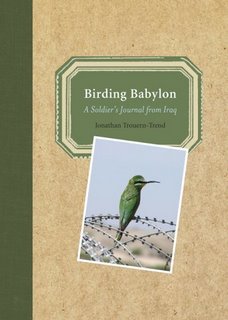
I want to let people know that I have a small book coming out May 1st based on some of my in-country entries from Iraq and Kuwait. The book is called Birding Babylon - A soldiers journal from Iraq. Its a collection of entries from this blog as well as a systematic list at the end. While not my magnum opus, it is nice to have something that might encourage a bit more interest in Iraq's natural history. The book is published by the Sierra Club and the University of California Press and is available online from the publishers and most major book sites. I'd like to thank Diana Landau and Orli Cotel from Sierra club who have worked hard on this project. I'd also like to thank Flemming Ulrich, a Danish Soldier and birder who allowed the use of his Blue-cheeked Bee-eater photo from Camp Eden, Iraq to be used on the cover.
About a week ago I went down to the Hackensack River in the Meadowlands of New Jersey. I met John Seabrook from the New Yorker magazine, who is writing a story on the book and my time in Iraq. We paddled around the marshes with a couple folks from Hackensack Riverkeeper, an environmental organization dedicated to protecting the river. We saw a few birds that I also saw in Iraq including a Moorhen, flying off into the marsh. The article should be out in Monday's edition of the New Yorker.
Last weekend I gave a talk at an Army Medical conference about human-wildlife interactions in Iraq from the Paleolithic domestication of the dog in northern Iraq to the bounceback of the southern Marshes today. It was a bit on the rough side but I'll be working on the brief to smooth it out a bit. I recently stumbled on the UNEP Iraqi Marshland Observation System. Each week they take imagery of the southern Marshes to chart the progress of reflooding and vegetation growth. Last week they measured the vegetation at 58% of historical levels. In March 2003 the Marshes were only 7% of their historical size.
Finally, I've started a new project called IraqFauna. It uses the collaborative Wiki model which allows anyone to edit and (hopefully) add to the contents. I have a number of goals for the site. One is to aggregate information on Iraq's animal biodiversity and stimulate interest for people inside and outside Iraq. I've posted my systematic list of birds I saw in Iraq and will start expanding the list with other people's sightings as soon as I'm done formating mine. I also put a page up on the Iraq Bioblitz Project, which I hope can move forward.

I want to let people know that I have a small book coming out May 1st based on some of my in-country entries from Iraq and Kuwait. The book is called Birding Babylon - A soldiers journal from Iraq. Its a collection of entries from this blog as well as a systematic list at the end. While not my magnum opus, it is nice to have something that might encourage a bit more interest in Iraq's natural history. The book is published by the Sierra Club and the University of California Press and is available online from the publishers and most major book sites. I'd like to thank Diana Landau and Orli Cotel from Sierra club who have worked hard on this project. I'd also like to thank Flemming Ulrich, a Danish Soldier and birder who allowed the use of his Blue-cheeked Bee-eater photo from Camp Eden, Iraq to be used on the cover.
About a week ago I went down to the Hackensack River in the Meadowlands of New Jersey. I met John Seabrook from the New Yorker magazine, who is writing a story on the book and my time in Iraq. We paddled around the marshes with a couple folks from Hackensack Riverkeeper, an environmental organization dedicated to protecting the river. We saw a few birds that I also saw in Iraq including a Moorhen, flying off into the marsh. The article should be out in Monday's edition of the New Yorker.
Last weekend I gave a talk at an Army Medical conference about human-wildlife interactions in Iraq from the Paleolithic domestication of the dog in northern Iraq to the bounceback of the southern Marshes today. It was a bit on the rough side but I'll be working on the brief to smooth it out a bit. I recently stumbled on the UNEP Iraqi Marshland Observation System. Each week they take imagery of the southern Marshes to chart the progress of reflooding and vegetation growth. Last week they measured the vegetation at 58% of historical levels. In March 2003 the Marshes were only 7% of their historical size.
Finally, I've started a new project called IraqFauna. It uses the collaborative Wiki model which allows anyone to edit and (hopefully) add to the contents. I have a number of goals for the site. One is to aggregate information on Iraq's animal biodiversity and stimulate interest for people inside and outside Iraq. I've posted my systematic list of birds I saw in Iraq and will start expanding the list with other people's sightings as soon as I'm done formating mine. I also put a page up on the Iraq Bioblitz Project, which I hope can move forward.
Friday, March 03, 2006
Bird Observations in Camp Victory/Baghdad Airport Area Oct 2005-February 2006
I've mentioned Joe H, an American birder who arrived in Iraq in October to work with the military. He's done a great service by providing monthly updates of his sightings while working at the large base complex near the Baghdad International Airport. If you are a military birder, its a good place to be stationed with a mix of several large lakes, scrub areas, some palm and eucalyptus trees, and reed-lined canals. I saw several great birds at Camp Victory, Camp Liberty and some of the smaller camps close-by including one of my favorites, the blue-cheeked bee-eaters which were fledging young next to one of Saddam's unfinished palaces - humorously named - Victory over America Palace.
Joe's tour came to an end at the end of February. He reports that during his stay he listed 64 species, of which 48 were lifers. Reading his posts will give you an excellent list of what to look out for during the late fall and winter. There are a few differences with what I saw a year earlier at LSA Anaconda around 50 miles north. Joe saw a better variety of ducks than I did including several species that I didn't see including Common Pochard, Red-crested Pochard and Gadwall. Like at Anaconda Northern Shovelers were sometimes seen in large flocks. I also had the impression while I was there that Anaconda had more rooks and jackdaws during the winter. Our nightly, noisy invasion of rooks with some jackdaws mixed in may have been because we were within a few hundred meters of a good size date palm grove where the birds would roost. Joe also saw a Blue Rock Thrush and some other birds I would have liked to see such as common kingfisher, skylark, marsh warbler and little bittern.
Read all his updates over at BirdForum.
To Joe - Thanks for your service and thanks for sharing your sightings.
I've mentioned Joe H, an American birder who arrived in Iraq in October to work with the military. He's done a great service by providing monthly updates of his sightings while working at the large base complex near the Baghdad International Airport. If you are a military birder, its a good place to be stationed with a mix of several large lakes, scrub areas, some palm and eucalyptus trees, and reed-lined canals. I saw several great birds at Camp Victory, Camp Liberty and some of the smaller camps close-by including one of my favorites, the blue-cheeked bee-eaters which were fledging young next to one of Saddam's unfinished palaces - humorously named - Victory over America Palace.
Joe's tour came to an end at the end of February. He reports that during his stay he listed 64 species, of which 48 were lifers. Reading his posts will give you an excellent list of what to look out for during the late fall and winter. There are a few differences with what I saw a year earlier at LSA Anaconda around 50 miles north. Joe saw a better variety of ducks than I did including several species that I didn't see including Common Pochard, Red-crested Pochard and Gadwall. Like at Anaconda Northern Shovelers were sometimes seen in large flocks. I also had the impression while I was there that Anaconda had more rooks and jackdaws during the winter. Our nightly, noisy invasion of rooks with some jackdaws mixed in may have been because we were within a few hundred meters of a good size date palm grove where the birds would roost. Joe also saw a Blue Rock Thrush and some other birds I would have liked to see such as common kingfisher, skylark, marsh warbler and little bittern.
Read all his updates over at BirdForum.
To Joe - Thanks for your service and thanks for sharing your sightings.
Subscribe to:
Posts (Atom)