Sunday, January 15, 2006


Falconry in Iraq

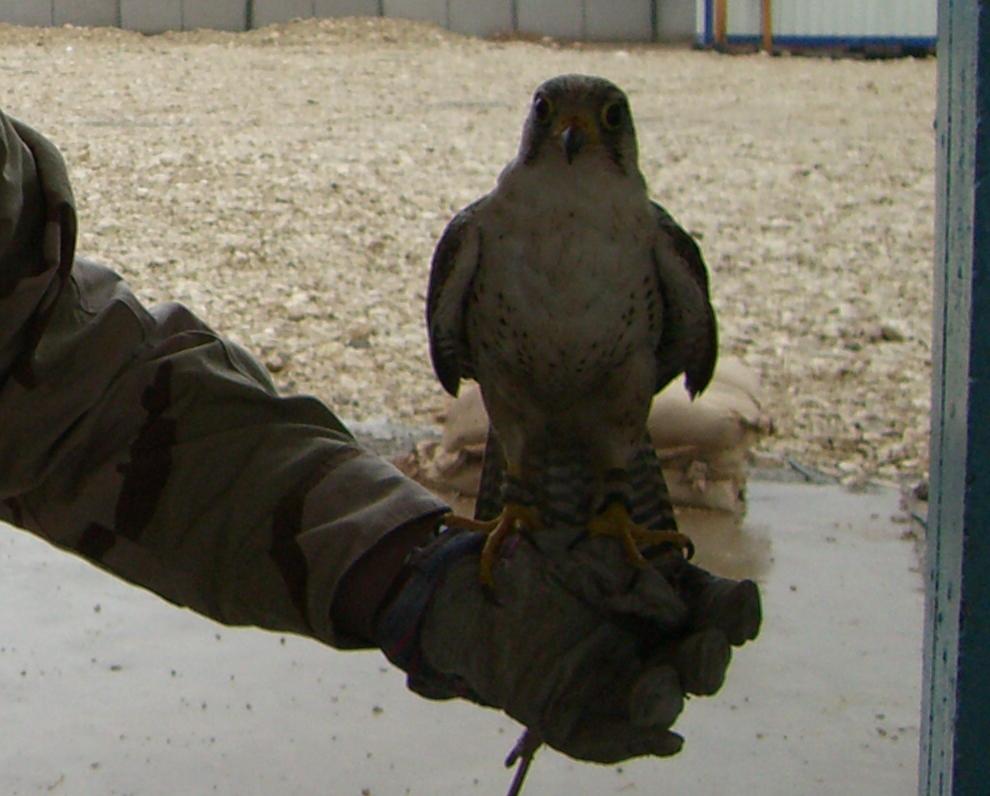
Dave, who has a relative serving in Iraq sent me a picture of a falcon from the Mosul area. An Army unit bought this falcon for a local man. He came and gave a demonstration for some of the soldiers. I think it's a Lanner Falcon (Falco biarmicus) but its hard to tell from the angle. The other possibility with those breast markings is a Saker Falcon (Falco cherrug). Let me know if you can give a more definitive ID. (Click on the picture to enlarge.)

Falconry is a very popular sport, especially in the Emirates and some of the other gulf states. It is associated with the traditional Arab way of life. According to Arabian tradition the birds would be released into the wild at the end of hunting season. This tradition has been continued for the last 11 years in Pakistan where birds from the Gulf States are released. In modern times people kept the best falcons year after year. In northern Iraq the sport is said to have been practiced for 2000 years. Some studies put the origins of falconry in the remote past. Each winter, wealthy Arabs travel places like Kazhakstan and Pakistan to fly their birds. This year, because of bird flu the hunters are sticking closer to home and hunting in Iran and North Africa. One of the favorite prey is the Houbara Bustard, a bird that is actually bred in the Emirates to try to replentish falling populations.

Many species of Falcons such as the Saker, Perigrine and Gyrfalcon are protected species and a black market has developed. A wealthy hunter may pay incredibe amounts (up to $40,000 dollars) for a bird that might have been trapped in Russia or hatched from eggs taken from the wild. Because of their investment owners spend lots of money taking care of the bird's health. Bahrain and Dubai even have Falcon hospitals.

In the past some falcons in Iraq were captured in the Sinjar Hills in northern Iraq. Many are also caught in China and Pakistan and sent to the Gulf Region. To try to deter the illegal trade the UAE has started a passport program for Falcons to try to track the legitimate birds entering the country. Now with bird flu there is concern that infected birds may come from the affected countries.

Saturday, January 07, 2006

Birds of Iraq: Pelicans

Many people think of Iraq as all desert. While true in parts of the south and Al Anbar province, Iraq is known for its water. The Tigris and Euphrates rivers have historically fed the large marshlands in the southern part of the country near Basra, Nasiriyah and Qurnah, the traditional site of the garden of Eden. Smaller marshes near Fallujah and Ramadi as well as lakes scattered around the country provide excellent habitat for wintering waterbirds.

Three species of Pelican are listed as being recorded in Iraq. Two are regular visitors and 1 is a vagrant.

Pink-backed Pelican - Apparently a rare visitor from its southern breeding grounds in the Red Sea and Africa. Even though this is one of the smallest pelican species it still has a wingspan of 8 feet.

Great White Pelican - A winter visitor to the marshes and lakes of Iraq. A high count of over 1200 birds was recorded at
Haur Al Hammar Marsh near Amara in the southern part of Iraq in censuses in the late 1970's.

Dalmatian Pelican
- A rare winter visitor to similar areas as the Great White Pelican. The high count at Haur Al Hammar was 81 birds, again in the 1970's.

Thursday, December 29, 2005

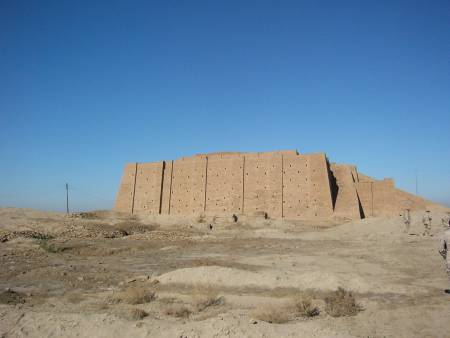
Pond at Tallil Airbase (Ali Base) December 2004. The Ziggurat of Ur is in the distance. I watched a pair of Pied Kingfishers, a Kentish (Snowy) Plover, a Grey Heron and a fine Male Black Redstart here. The city of Ur was the traditional home of the prophet Abraham.


Though this blog is focused on Iraqi wildlife I will make a little detour on this entry.

A reader soon to deploy to Afghanistan asked a few questions that I'll try to answer here.

The first is: what resources are there on Afghan birds? I've only found a few references since Afghanistan has been somewhat neglected since the 1979 Russian invasion. A few old British texts describe the wildlife of the region. Birdlife international has a review of the birdlife of Afghanistan which has a mix of palearctic and oriental species and 460 recorded species. There is one Afghan endemic, Afghan Snowfinch (Montifringila theresae). Happily we have one recent trip report of 82 species made by Anssi Kullberg combining the observation of 4 trips through Afghanistan in 2002. Some spectacular birds are to be seen. A birder from Iraq would recognise many of the familiar favorites: Magpies, Hoopoes, Crested Larks, Pied Kingfishers, Indian and European Roller plus many others. They would also be treated to birds of Indian origin like Brahminy Starling, Black Drongo and House Crow. Some truly exotic birds like the Himalayan Monal, a colorful and rare pheasant, are also on the Afghan list. A somewhat pricey two volume guide has been published this year by Lynx in Spain. The Birds of South Asia is the first guide to fully cover the birds of Afghanistan and at slightly less than $100 US is a good investment for someone spending a long time in Afghanistan.

Another question involved digiscoping and blogging from a forward deployed area. Others may want to add their 2 cents here. I did not have a great camera for birds, nor a scope. If I had to do it again I would try to bring both. I missed a lot of birds because they were out of binocular range.

I found that blogging anonymously is the way to go. It simplifies things considerably and makes the command much more comfortable with your blogging in general. My self imposed rules were very strict because of my role in battalion intelligence. I never revealed my name, my unit or my location in the country. We had many incidents that I never wrote about on my other blog because a relatively smart person could identify my location from the incident and perhaps use it for battle damage assessment. When it came to my wildlife watching, any and all my writing was seen as universally innocuous and not an operational security issue.

I've started posting again on HomeRange, my general natural history blog. It started out as my nature observations but I let it slide in back in May. I recently changed the focus to whatever I feel like writing about, from my observations to interesting news items.

Wednesday, December 21, 2005

Michael Yon, one of my favorite bloggers in Iraq, has a contemplative post with lots of bird pictures he's taken in the last year. These include White-cheeked Bulbuls, Mesopotamian Crow and Spur-winged and White-tailed Plovers. I'm always pleased when I find someone, especially a soldier or former soldier in Michael's case, is interested in birds. It is an indicator to me of a person who can get outside of their immediate personal concerns. I guess it reminds me of the archetypal gentleman soldiers, renaissance men like the some of the British soldiers in the Mesopotamian campaign who compiled their observations of birds, mammals, plants and archeology into reports published by the Bombay Natural History Society. Or General Sir Alan Brooke, Chief of the Imperial General staff, enjoying a short walk watching goldfinch and stonechats on the eve of the Normandy invasion. I'm not sure if its coincidence or not but many of these multidimensional characters that I've met have been Marines. I'm not sure if there is something about the Marines that draws the soldier-scholar. Several I have met have been incredible students of history and culture and impressive intellectuals.

On another note I bought a copy of A Systematic List of the Vertebrates of Iraq by Mahdi and Georg (1969). There are 385 species of birds listed. Its a start to a comprehensive Iraq list. Avibase lists 416 species. It will probably be a few years before there is an Iraq Rare Records Committee and an official Iraq list.

Thursday, November 24, 2005


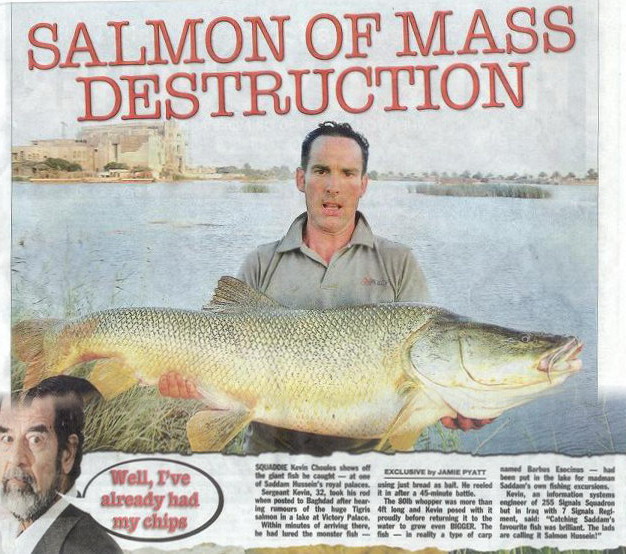
Tigris Salmon or Pike Barb (Barbus esocinus) - Iraq's largest freshwater fish. Reputed to grow up to 6.5 feet long and weigh a few hundred pounds. This picture was taken at Camp Slayer near Baghdad International Airport. Note the palace in the background - Saddam called it Victory over America Palace. When I was at Slayer I saw some huge fish splashing around. I also saw announcements for a fishing contest. I think this would have won it at around 75 pounds.


The weather in Iraq has cooled down considerably. Many of the winter resident birds have returned to Iraq. The huge flocks of rooks, the most social of the crows, have come back as well as the ducks and shorebirds. The nightly spectacle of thousands upon thousands of rooks returning to their roosts after a day of foraging in the surrounding farmland will treat both the residents of the surrounding villages and towns and some of the new troops at LSA Anaconda. Sometimes the rooks would gather in large groups and form a tight spinning column as they rode a thermal.

Last year around this time I gave an interview on NPR about my birding in Iraq.

Mudhafar Salim, an Iraqi ornithologist with the Iraq Nature Conservation Society who has been working with Birdlife International on their surveys of the southern marshes has posted a series of great photographs from some of his fieldwork earlier this year. He has photos of 17 species including the endangered Basrah Reed Warbler, Little Crake, Marbled Teal, Slender-billed Gulls and European Scops Owl.

Included in Mudhafar's other marsh pictures is a shot of 4 fish caught in one of the marshes. I haven't been able to identify the catfish (Possibly an introduced Asian Stinging Catfish), but the other three fish are Mesopotamian Spiny Eels ( Mastacembelus mastacembelus). Other members of this interesting group of fish are kept as aquarium fish, some growing over 3 feet long. Captive fish have a habit of burrowing in the gravel to either hide or look for food. Wild fish most likely do the same hunting for food or hiding from predators.

Brian Coad, a Canadian scientist working with the Canada-Iraq wetlands Initiative is working on a document on the freshwater fish of Iraq. So far he has a checklist and bibliography up. It seems like he has done a lot of work separating out the valid records from records from erroneous reports. Its good to see someone working on a biodiversity project like this. This should be a great resource when completed. Iraq has a number of interesting species including blind cave fish and a large and diverse cyprinid (carp and minnow family) fauna. An added bonus is this document should be a boon to the many coalition troops who enjoy fishing on their off time and catch unusual fish that they can't ID. Perhaps one day there will be fishing outfitters on the Tigris and Euphrates ready to cater to tourists who are after that giant Tigris Salmon. Here's some pictures from a Navy guy in camp victory who brought his flyrod. He also caught a good sized Tigris Salmon as well as some large elongated cyprinids that almost look like a cross between a mullet and a carp. Other species that are being regularly caught is the Asp (Aspius sp.), big-head carp and a large catfish related to the giant wels of Europe and Asia. Some more pictures can be seen at this website. Just scroll down and look for the guys in desert camoflage.

The fourth rotation of US troops is well under way and there are more birders among them. LTC Bob at Camp Victory may be back stateside already. He recently had two more posts. One on the Indian Roller and another on Purple and Grey Herons. Out in Al-Anbar province one of the Marines, Michael Fay has been watching the birds in his spare moments, he also happens to be their artist in residence and has just returned from covering the heavy fighting near the Syrian border. A possible successor to LTC Bob in the Camp Victory Area is Joe H. who is about 1 month into his tour. He posted some of his sighting at birdforum.net