Friday, January 05, 2007

Another Lesser White-Fronted Goose tracked from Siberia to Iraq

In 2004 a satellite tagged Lesser White-fronted Goose was tracked from its nesting grounds in Siberia to its wintering grounds in Iraq. For the first time the entire round trip migration of a single bird of this species was documented.

The LWFG is a globally threatened species that has experienced a significant population decline and is assessed to be a moderate to high risk of extinction due to habitat fragmentation and hunting pressures. Almost nothing is known about the population wintering in Iraq. Populations in Azerbaijan and Iran have seen dramatic decreases according to to waterfowl biologists.

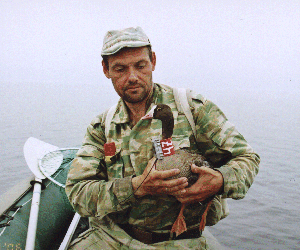
In July of this year in the Putorana Plateau in the Ural Mountains of Russia, another group of this threatened species were tagged with satellite transmitters. The birds were captured by netting them from a boat on open water during the post-breeding moult, when they cannot fly for a number of weeks (see photo above) . Of the six birds, only 2 were still transmitting data as of December 2006.

Both birds had arrived at a reservoir on the Iran/Azerbaijan border near the Azerbaijani city of Nakhichevan in Early November. One bird had made its way to the Euphrates Valley in Syria by early December, just over the Iraq/Syria border. Currently this bird is spending its time in a wetland area about 50 km north of Al Qaim in Al Anbar Province. The bird has been tracked as close as 5 miles from the Iraqi border.

The second bird was still in Azerbaijan on December 25th. On December 29th the bird had moved 650 km south to Maysan province in Iraq very close or in the Birdlife International IBA of Haur Al Sa'adiyah. Much of the area appears to be agricultural land now. Surveys of the area in the 1960's and again in 1979 recorded large numbers of wintering waterfowl and shorebirds including Ruddy Shelduck, Pintail, Gadwall, Wigeon, Shoveler, Teal, Mallard, Greylag Goose and Greater Flamingo. In 1979 up to 2500 Common Cranes were wintering in the area.

On January 5th, 2007 the bird had moved about 60 km northwest to a rich agricultural area approximately 25 km east of the city of Kut in Wasit Province. It would be interesting to find out where this bird is feeding since Wasit Province reported a bumper crop of both Wheat and Barley this year. In some other countries, the government has paid farmers to leave some grain in the field for waterfowl.

This bird is visiting some of the same areas as the bird tracked from Siberia in 2004/2005. The surveys of the southern Marshes of the last several years have demonstrated that these wetlands remain an important wintering area for Eurasian waterfowl.

Thursday, October 05, 2006

Speaking in New York City on October 10th

I'll be giving a talk for the Linnaean Society of New York at 7:30 pm on October 10th at the American Museum of Natural History. Admission is free. Please enter at West 77th street between Central Park West and Columbus Avenue. The talk will be held in the Lindner Theater.

I'm looking forward to sharing some good things happening in Iraq. In the talks I've done before, I always meet some great like-minded people.

Sunday, August 20, 2006

Iraqi Hunters and Conservation

I came across the website of the Iraqi Hunters Association . The gallery has a few photos from hunts in Iraq showing Black Francolin, Ruddy Shelducks and Greylag Geese. There is also a wildlife page with some interesting commentary on different species of Iraqi game and non-game wildlife. According to the site the Houbara Bustard has declined significantly and methods such as using nets and lights (jacklighting) are used to hunt them. They suggest all methods be banned except for the traditional use of trained falcons.

The website got me thinking about hunting and conservation. Among the goals of the association are setting bag limits for species that have populations that can support hunting and banning the taking of species that are threatened. They also espouse the conservation of habitat and better land management.

Prior to the war, hunting was popular in Iraq. One of our clinics near Baghdad was Saddam Hussein's hunting lodge. In the winter, good numbers of waterfowl come to the surrounding lakes. These days walking around with a shotgun or hunting rifle just might get you killed.

In the US there are many hunting organizations that have a large conservation component such as Ducks Unlimited and the Rocky Mountain Elk Foundation. Hunters are often natural partners in conservation and have a deep appreciation for nature. Some organizations and governments have conducted auctions of big game hunting permits to fund conservation programs. The US Fish and Wildlife Service issues Federal Duck stamps to fund the National Wildlife Refuge program. Every US hunter must purchase a stamp annually if they want to hunt migratory waterfowl. The money is used to buy or lease wetland habitat.

I think its a good sign that there are people in Iraq thinking about sustainable hunting. There may be opportunities for international groups to get involved. Perhaps correct management of some big game animals such as gazelle or Ibex could allow limited hunting where licenses could fund local conservation programs. The verdict is still out on the cost-benefit of these type of programs, but it could be an option. In Pakistan limited trophy hunting of Markhor, Ibex and Blue Sheep have shown some success. License fees have allowed game wardens to be hired and significantly reduced poaching since it cuts into the local communities potential revenues. Hunting permits for the endangered Markhor are auctioned and went for 25,000 to 55,000 US dollars last year.

Sunday, August 13, 2006


More Birding from the Victory Base Complex

John and Marc have some great pictures up on the Yahoo group Operation Iraqi Birds. Both are serving on the Victory Base Complex in Baghdad and seeing some good birds.

Among recent sightings have been Little Grebe, Pygmy Cormorant, 3 species of Kingfishers (Pied, Common and White-breasted), Wattled, Spur-winged and White-tailed Plovers, Black-winged Stilt, Common and Iraq Babblers, Squacco Heron, Little Egret, Blue-cheeked Bee-eater, Black Francolin, Wood Pigeon, Collared Dove, Rufous Bush Robin, Magpie and Graceful Prinia. There are many nice photos in the gallery on the OIBirds site.

One of the recent pictures showed at least 3 additional species of smaller shorebirds (One was most likely a redshank). Now is the time to start looking for the migrants coming from the far north.

Sunday, July 30, 2006

Iraq records a critically endangered bird

One of the rarest birds in the world, the Northern Bald Ibis has been satellite tracked to extreme western Iraq during its migration south from the breeding grounds of the tiny remenant population of 13 birds in Syria (discovered in 2002) to Yemen. The name of the male bird tracked through Iraq is Salam (Peace). Hopefully, this name will be prophetic for both the birds and Iraq.

The bird was recorded in Iraq on the morning of July 18th having flown 207 km from its breeding grounds in Palmyra, Syria since the day before. The bird is currently in Western Yemen along with two other tagged birds.

The fact that there are more Northern Bald Ibis in capitivity than in the wild highlights their tenuous hold. Another small wild population exists in Morocco.

The bird once found throughout Europe and the Middle East has experience a spectacular decline. A colony in Turkey dropped from 600-800 pairs in 1954 to 6 pairs in 1980. It was last wild birds nested in 1989, when the remaining few birds were captured for a captive breeding program.

I previously had the Northern Bald Ibis listed as extirpated on the Iraqi list. I've happily changed the Bald Ibis status on the Iraqi checklist from extirpated to rare visitor. Historically there were a few colonies in Iraq. I couldn't find any references, save a map in the IUEP Action Plan for the Northern Bald Ibis.

After going undiscovered for so long in Syria, perhaps there is a chance that other relict colonies exist in Syria and maybe even remote areas of Iraq.