Return to Babylon
It's official. I will be back in Iraq in a matter of months for a year long command performance. Another year in Mesopotamia. I am not looking forward to being away from my family and friends for so long. I am looking forward to my medical mission as well as getting more familiar with the flora and fauna of Iraq.
Perhaps, I'll get a chance to meet, and maybe work with, some of the Iraqi Environmental NGOs who are doing such great work in the country.
Though, I can't hope to match Mudhafar Salim's Iraq bird list I hope to at least reach 160 species. I think a trip to Kurdistan and my usual movement around the country should make that attainable. I think just identifying some of the Old World warblers that went in the unidentified category last time will put me well on the path.
Since last year Major Randall Rogers has been putting out a great natural history newsletter from Al Asad Airbase in Al Anbar Province called Al Asad au Natural. He's a longtime member of Columbus Audubon Society in Ohio and did a good bit of birding while in Iraq. He is soon returning from deployment. Reading through the archives of Al Asad au Natural gives a great education into the natural world of Iraq both past and present. The entire archive is on the Columbus Audubon website.
I love the format of Al Asad au Natural. Maybe I can try something similar when I'm deployed. Time will tell.
Time to pack up the Binos and get a better camera.
Tuesday, December 09, 2008
 Birding in Tallil
I've been remiss in not writing about this sooner. The November/December 2008 Birding magazine, published by the American Birding Association, has a fantastic photo essay of birds observed and photographed by Colonel Thomas Dove, a physician who served at Tallil Airbase near Nasiriyah in Southern Iraq. The ruins of ancient Ur are just next door to the base.
Colonel Dove served in Iraq from October 2007 to June 2008. He accumulated an impressive list of species and photographed over 100 species. I laughed reading his account of a particular "No Swimming" sign popular with a group of Pied Kingfishers. When I visited the base in December 2004 one of the kingfishers was beating a small fish against the sign to emphasize the point!
The photos are spectacular and the essay echoes the sentiments of many people who have found beauty and inspiration in Iraq's avian residents. I'm particularly jealous of his sightings of Greater Flamingos, which I never saw. A picture of 2 of the flying flamingos is featured in the article.
Thanks Col. Dove for your first rate pictures and article.
Online version of Birding in Iraq - A photo Essay by Col. Thomas Dove
Additional Web Content - Hard to Identify Old World Warblers from Tallil
Thursday, July 10, 2008
Birding the VBC
I think the future "Where to find birds in Iraq" will have to include the cluster of bases near Baghdad International Airport (Victory Base Complex). These include Victory, Liberty and Slayer. I would guess that the aggregate list could be approaching 200 species between all the folks who have been watching birds there in the last 5 years. Some of these include White-headed Duck, Great White Pelican and Darter. The ponds, reedbeds and trees make it a nice migrant trap for waterfowl, shorebirds and passerines. For a while, there were even articles in the local base paper on the common birds seen around the area.
Matt Pike took some great pictures of many species while there. He has a gallery of around 120 species with fantastic photos. He saw species such as Darter and Basra Reed Warbler.
Many of the messages and photos on the Operation Iraqi Birds forum started by John Duresky relate to observations at VBC.
There are also recent photos and posting from LTC Bob from his second tour at VBC. His entire archive can be found here.
Friday, February 16, 2007
Lesser White-fronted Goose at Samarra Dam
On Feb 4, the Russian group tracking the remaining two Lesser White Fronted Geese that are transmitting signals from their tags showed the bird that has spent much of the winter in Syria moving to the large wetland at Samarra in Iraq. The Samarra Dam Area on the Tigris River is a designated important bird area (IBA). The Samarra Barrage is composed of two dams, a flood control dam (also called the Tharthar dam locally) and a Hydroelectric generation dam. Samarra has great cultural significance and unfortunately was where the golden dome of the Al-Askari Mosque was severely damaged last year, precipitating a wave of violence. Samarra also has the famous Great Mosque with a unique spiral minaret. In a future more peaceful Iraq, Samarra would make a good place for a field station/ecotourism site.
Seeing that this goose had made its way to a area that has been a focus of violence was very symbolic for me. In the midst of violence something magical, a bird that has travelled over 3000 miles from Siberia and the fact we can see where its been.
The Tigris was dammed at Samarra in the early 1950's to control the flooding of Baghdad. A large wetland was created behind the dam. A canal diverts floodwaters to Lake Tharthar, a large artificial lake that was once a depression between Samarra on the Tigris River and Hit on the Euphrates.
According to Birdlife International 146 species have been recorded in the vicinity of the Samarra Dam including the globally endangered Sociable Lapwing and many species of waders and waterfowl. Breeding at the site is the near endemic Grey Hypocolius, the bird illustrated on the cover of the new Field Guide to the Birds of Iraq.
Waterfowl hunting was once common in the marshes near Samarra so hopefully the tagged LWFG will continue on his journey. If not, we may see a signal coming from a house in Samarra as was the case with one of the other tagged geese when it was taken by a hunter in Russia.
Sunday, January 28, 2007
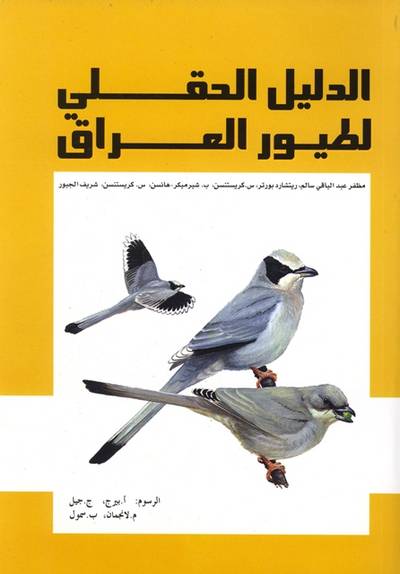 Field Guide to the Birds of Iraq - An important Milestone in Iraqi Conservation
Birdlife International and Nature Iraq announced the publication of the first Arabic language field guide to the country's 387 recorded bird species. In fact the Field Guide to the Birds of Iraq is the first comprehensive, fully illustrated guide to any Arabic speaking country. The book has been a collaborative effort by Nature Iraq (I know Mudhafar Salim worked hard on it as well as other biologists and field workers), Richard Porter, author of the Field Guide to the Birds of the Middle East (recently released in Arabic) and Birdlife International. Funding for the project was provided by The Canada-Iraq Marshlands Initiative, the Ornithological Society of the Middle-East, Avifauna and The World Bank.
Since I first heard of the project from my friend Mudhafar, I have felt that this would be an important and exciting step in increasing the Iraqi public's awareness of their natural treasures and giving added visibility to the country's environmental movement. With a field guide it becomes possible for large numbers of people to participate in studying the country's birds as the knowledge of identification is spread. Now we need an Iraqi eBird for large scale collection of observation data.
I naturally thought of my experience as a child looking through field guides and the spark it provided to my interest in nature. I also thought of my experience with children in Iraq when I visited schools to bring books and supplies. At the very least each school in Iraq should have a copy of this book. I imagine in the next few months and years, a child will crack open the Field Guide to the Birds of Iraq for the first time. First they will look for the familiar birds, the Laklak (White Stork), the Hudhud (Hoopoe) or the Wood Pigeon. They will come back to the book and see birds they never knew existed. For a few, the spark of curiosity will become a flame of a lifelong passion, perhaps when they realize these exotic creatures live, not in some far-off place, but in their own country. I fully expect that some of Iraq's next generation of naturalists and scientists will have started their journey when they discovered the world was larger and more wonderful than they had imagined when they opened this book.
I've discussed the idea of raising money to enable the widest distribution of this important book with a few people both here and in Iraq. I think it is a very important project and I'll follow up with some details as they are worked out.
Again, congratulations to all involved in the publication. I pray you reap a hundred-fold for your efforts.
Subscribe to:
Posts (Atom)