Monday, December 06, 2010


eBird now available for Iraq sightings

I have a lot of observations written in my notebooks from my last deployment to Iraq (October 2009 to July 2010). Now I have an outlet where I can put them all. My lists on this blog are not too useful since they are static and the data cannot be manipulated.

eBird is a project of the Cornell Laboratory of Ornithology that was launched in 2001 to automate the collection of bird observation data. It includes maps, checklists and statistics. The aggregate data is available on the web.

In June of 2010 global eBird was launched which allows entry of observations from around the world. The interface worked very well with my Iraqi observations. If a species is rare or numbers are large the interface asks you to confirm the data before submitting. I was asked to confirm for Barn Swallows in February and for an observation of 150 Wood Pigeons, both routine occurances, so its not perfect.

There was almost no data for Iraq, so I'll be entering mine. I encourage everyone with Iraq bird observations to enter the data in this system, it will be very valuable for those studying Iraqi Avifauna since the system can do such things as generate maps and create checklists and frequency data.

eBird Website

Monday, November 22, 2010


Nature Documentary featuring Iraq

A couple of weeks ago the PBS program Nature featured the work of Azzam Alwash and the staff of Nature Iraq. I made a point of watching it with my kids. Like Azzam, I am optimistic that one day ecotourism will flourish in Iraq. Save the violence, which decreased exponetially between my 1st tour in 2004 and my second in 2009/2010, the country has the right combination for successful ecotourism. I can imagine visiting the ruins of Ur and Babylon then birding Marshlands National Park looking for Sacred Ibis and African Darter to add to my life list. Perhaps my third trip to Iraq will be the one where I can leave my weapons behind.

Again I cannot give enough accolades to Azzam and his staff at Nature Iraq for their tireless and critical work protecting and understanding Iraq's Natural treasures. A special hello goes to my friend Mudhafar Salim, a tireless ornithologist who I saw in action with Azzam in the documentary.

Full Episode - Braving Iraq

Thursday, June 24, 2010

In March when we still had a significant amount of green around our building, with lots of small orange flowers we had a lot of butterflies visiting including two types of Blues (the one pictured and a tiny species with a wingspan perhaps half an inch across). Also we had a good number of Cabbage Whites and Painted Ladies. In April, as the Eucalyptus trees flowered, we had massive numbers of Painted Ladies on base. I counted over 300 in a short walk to the gym and back. For a week or so they were everywhere, including getting in the buildings. I had the same experience with a sudden explosion of painted lady numbers at the same time as the Eucalyptus flowering. Recently I have been seeing some more blues and this butterfly (some type of Nymphalid) with dark wings and orange spots.


Wednesday, June 23, 2010


Today we are having a nice dust storm. The White-cheeked Bulbuls around the building were very active today dispite the dismal weather. This one was singing its heart out in our mulberry tree and chasing house sparrows around.


In the past week or so I have been hearing extremly loud clicking sounds coming out of the trees around base. I thought they were either katydids or cicadas. It has been incredibly hot, hitting around 117 degrees F for several days in a row. The critters making the sounds didn't seem to mind the scorching temperatures.
Several days ago I was walking back to my trailer at about 2 AM, the temperature was still in the nineties. In one Eucalyptus tree next to a portable construction light had what sounded like dozens of the clicking critters. After a second of searching I found the culprit, small green cicadas with blue eyes! The color was incredible and contrasted dramatically with the dust covered leaves. I caught a few and went back to my building to get my camera. The cicadas buzzed angrily like little toy noisemakers in my hands. Two soldiers smoking outside didn't know what to make of the noise when I walked up.

When I went back to the tree there were cicadas buzzing around the construction light and bats circling catching insects. I have not seen or heard any large aggregation of cicadas since. I'm wondering if there was simply a large emergence and then dispersion.


Thursday, June 17, 2010

Treefrog


One of our soldiers found this tree frog in a portolet and brought it to me. I let it go in the reeds of the north retention pond. I think it is Hyla savignyi

Tuesday, June 15, 2010

JBB Laundry Pond
In May my birding partner and I drove up to the laundry pond and found a small group of little terns resting in the road. Its a little hard to believe but I've seen 4 species of tern here on base since last fall. Two are marsh terns and seem to be fairly common during the summer here, the white-winged and whiskered terns. I saw the fourth species just two days ago at the north retention pond with a Common Tern joining in with the Stilts that were mobbing me as I walked along the shore.
Here's the lists for 2 days in May. I was surprised to see a female white-headed duck staying around so late in the season. Up to 9 White-headed ducks have been present on JBB since October. The several acre laundry pond seemed to be to their liking, though I also saw them at the smaller north retention pond. Here's a picture from earlier in the season.


19 May 2010
0530-0645 Laundry Pond
Little Grebe – 20
Ferruginous Duck – 10
Kestrel -1
Coot – 1
Moorhen – 2
Purple Swamphen – 1
Collared Pratincole – 4
Spur-winged Plover - 3
Little Tern – 10
Crested Lark – 2
Blue-cheeked Bee-eater - 6


23 May 2010 -
0530 – 0830 South Laundry Pond and North Retention Pond, JBB Iraq
Observed small fish in Laundry pond – singles and small schools 2 inches or less
Little Grebe – 20
Pygmy Cormorant – 1
White-headed Duck – 1 female
Ferruginous Duck – 10
Marbled Teal - 2
Kestrel -1
Coot – 2
Moorhen – 6
Purple Swamphen – 1
Little Bittern – 2
Black-crowned Night Heron - 3
Collared Pratincole – 1
Stilt - 10
Spur-winged Plover - 6
Little Tern – 3
Whiskered Tern - 1
Crested Lark – 10
Barn Swallow - 35
Wood Pigeon – 8
Rock Pigeon – 12
Collared Dove - 4
Blue-cheeked Bee-eater – 6
Grey Hypocolius – 1
Lesser Grey Shrike - 1
Graceful Prinia - 5
House Sparrow – 20
Hooded Crow - 4


Thursday, June 10, 2010

I was up at the north pond checking out the wildlife. The Black-winged Stilts were making a racket and flying around. A few days before I thought I had seen some chicks running into the reeds. I found this little fuzzball under a big rock by the water when I was looking for frogs (there was also a frog under the same rock). The stilt chick didn't move a muscle for a minute or so then ran down to the water and surprised me by swimming away, paddling along with its ridiculously long legs. The adults really went wild when the chick belted out its alarm call and started trying to crap on me and the other sergeant with me. Later in the day I saw 2 more chicks feeding out on the mudflats.
Making a getaway


Friday, January 29, 2010

For a month or more we have had butterflies visiting the small flowers
around the building. Sometimes I go outside in the middle of the day
and I'll see 20 or more butterflies flitting around and feeding on the
little orange and yellow flowers. I've only seen Cabbage Whites and
Painted Ladies. This past week I have started finding spiny painted
lady caterpillars in little silk shelters on the Mallow plants growing
in an open area near us. Since there are holes in the leaves
surrounding the shelter, I'm assuming that the caterpillars come out
at night to feed.

The Painted Lady is one of the most widespread butterflies in the
world. It is found on every continent except Antarctica and South
America. In 2004 I saw hundreds of these butterflies when our
Eucalyptus trees started flowering. Last week, our large Eucalyptus
had the first of its little puffball flowers open, so I may be seeing
a lot more butterflies soon.

Some other insects are visiting the flowers also including large
hoverflies that look like the Drone Fly (Eristalis tenax).

On the bird front I watched a group of White-cheeked Bulbuls feeding
on the ground with a few house sparrows. I've heard from others that
the Bulbuls will eat such things as cookies that people put out for
the birds.

Monday, January 25, 2010


Yesterday we went back out to the Laundry Pond. The sun rising behind us provided great lighting on the ducks and coots that were floating in loose groups out in the pond. The weather was fairly cool at about 45 degrees F. As we walked through the Phragmites, the coots were making crazy noises out on the pond. The White-headed Ducks moved out to the middle of the pond in a small group of 7 birds. They ride very low in the water, almost like they are in the process of sinking. We had some great views as they stretched and flapped their wings. The males white heads stood out among all the dark plumaged coots. About a dozen Mallards were swimming around and later flew back and forth from one side of the pond to the other. The Ferruginous Ducks seemed to be venturing more into the open water than usual. Mostly they stick to the shoreline and the reeds. The contrasting light and dark pattern of the Male Shovelers made them easy to pick out on the far side.


There is a section of the pond where the reeds have been cut back and a noisy water pump has been installed. The opening is a good vantage point to count the birds in the middle of the pond and to get a closer look at the reedy edges. There were more Common Teal than last week, probably 20 or more. In a muddy area near the reeds we found 4 Black-winged Stilts resting. Later they flew over the pond trailing their long, elegant red legs behind them.


There are large patches of greenery in areas around the pond that were bare a few months ago. The winter rains prompt furious growth of small herbaceous plants in the ditches and open fields around the base. Many are familiar roadside weeds such as dandelion and mustards. There are also quite a few small orange and yellow daisy-like composites and areas of grass. We stopped and found some ladybugs in a patch of low growing compositae. I also saw quite a few small striped hoverflies on the flowers. Other plants, such as the thistles, seem to be just getting going with small prickly rosettes appearing here and there. We can expect a few month more with occasional rain, so I expect at least some greenery to remain into April. After the heat gets going all these plants will be baked into oblivion, until the rains come again in late Autumn. It amazes me how hardy the seeds are, surviving ground temperatures that have to exceed 150 degrees Fahrenheit for month and months.


Since it was getting late we picked up the pace to get back to the truck. In the corner of the pond we found a White-throated Kingfisher hunched up, resting in the Phragmites. It's brilliant blue back and large, bright red bill contrasted with the dull brown reeds.


We found a small group of European Goldfinch in the same bushes as last week.


Out on the airfield, we saw hundreds of Wood Pigeons and Rooks. Large flocks of hundreds more Wood Pigeons were flying around the perimeter fence. A flock of about a hundred small brown birds wheeled around and landed near us. After a good bit of deliberation we decided that they were most likely Short-toed Larks.

Tuesday, January 19, 2010

This past Sunday we got back out to the laundry pond again. As usual, the pond was loaded with waterbirds. I counted 525 Eurasian Coots swimming around in the middle of the pond and feeding in the reeds. The group of White-headed Ducks that have been present since October were still at the pond with 7 birds, both males and females. We watched a female from very close range coming out of the reeds on the east side of the pond. A good number of Shovelers were present in the pond when we arrived, then started flying around in small flocks when the F-16s roared off the runway behind us on afterburner.

A few other ducks species including Common Pochard, Gadwall, Common Teal and Ferruginous Ducks were present in smaller numbers along with a handful of Little Grebes.

We completely circled the pond for the first time. Usually, we park on one side and remain there. On our way back we saw some activity in a patch of vegetation near the entrance road. It turned out to be a flock of several dozen European Goldfinch. We got some great closeup looks at these beautiful birds as they appeared to be feeding on thistle seeds. As we were moving back to the truck we found a group of Spanish Sparrows with their bold chestnut, black and white plumage.

The highlight of our visit to the pond was watching two Jackals running back and forth on the edge of the pond, chasing and being chased by a Red-wattled Plover. The bird dive bombed them, while they charged around. After about five minutes, they noticed us and stopped to stare, then trotted off into the open area toward the west side of the base.

Around Sunset I returned to the area and I saw the pair of Jackals again yelping and chasing eachother around.

After the sun went down, I heard large numbers of Green Toads calling in the irrigation ditches near the west side of the base. It reminded me of the spring choruses of various frogs and toads in Connecticut. I guess Spring comes to Iraq in Mid-January.

Friday, December 18, 2009

Christmas Bird Count - JBB, Iraq

I've been here in Iraq since the beginning of October. I am currently at Joint Base Balad, formerly LSA Anaconda along the Tigris River north of Baghdad. I usually have been able to go birding for a few hours most Sundays early in the morning with a Sergeant from another unit. Together we are the only current members of the JB3 or Joint Base Balad Birders.Much has changed since I was here 5 years ago. One good change is there are more ponds and lakes to look for birds in. Another benefit is that the mortar and rocket attacks are much more infrequent.

The Laundry Pond where I saw so many birds in my previous still is the most productive area for birds on base. The first time we went there in October there were so many waterbirds, it reminded me of the Everglades. The comical Purple Swamphens clambered over the reeds, while dozens of Little Egrets fed in the shallows. The little grebes dive and pop up everywhere, while the coots and moorhens exercise their full vocal range from the reeds. Among the large rafts of coot and Northern Shovelers, we have found smaller numbers of Common Teal and up to three White-headed Ducks, threatened relatives of the Ruddy Duck of North America. These distinctive small ducks were a surprise for me and my first lifer for this trip to Iraq. Another duck that we see frequently are the spectacular chestnut colored Ferruginous Ducks, which seem to prefer the edges of the pond, near the reeds. When they fly they show large white patches on the wings and are very striking. One morning we saw some Common Pochards, another new species for me. The Common Pochard looks very much like a Redhead or Canvasback from back in the US.

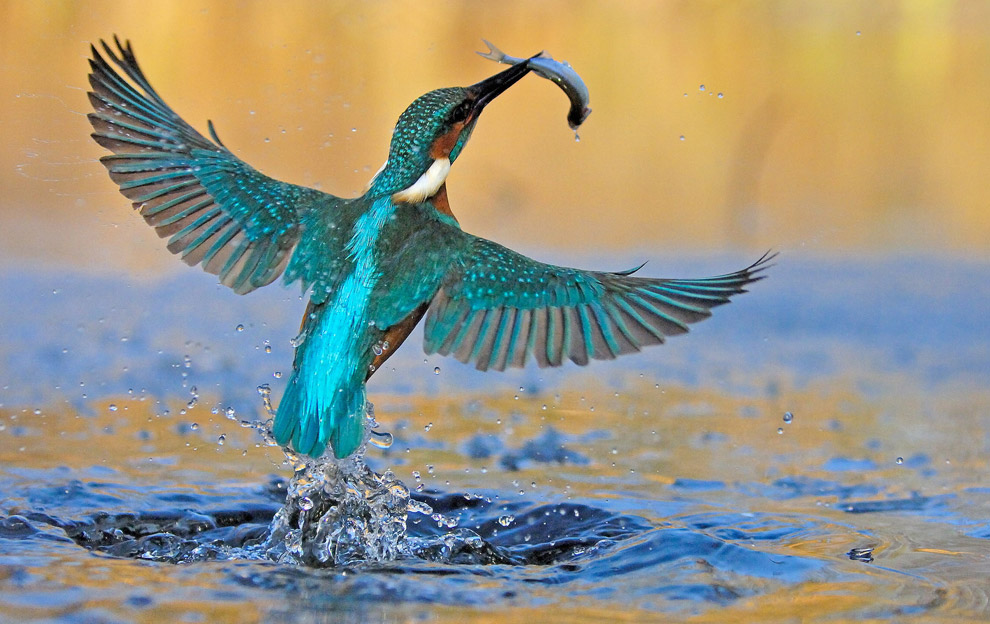
When I went down to Baghdad, I saw a brilliant Common Kingfisher. This bird has iconic status for me, being such a striking species and one that I heard my father describe from his boyhood in southern England, hunting along shallow streams. When I was in England I had hoped to see it, despite scoping out some of the very same streams as my father, I never saw one. My first Kingfisher appeared to me, like a flashing blue diamond, cutting through the brown surrounding the pond I was checking out as it flew past me. I think its known as Bass Pond at Victory Base. I was amazed at the kingfisher's speed, how small it was and its otherworldly colors. Various shades of electric blues with a chestnut breast. The Kingfisher landed on a cement block next to the pond, which already had a Pygmy cormorant and a Little Egret. For ten minutes I watched this little blue sprite preen itself, then dive into the water to retrieve a fish, consume it then go back to flitting around.

Right now, I'm planning a Christmas Bird Count here at JBB. The Hartford CBC is always something I look forward to and I plan to be back to next year. I have found our local Rook roost, so perhaps we'll start there counting the thousands of playful, mischievous bare-faced rooks, mixed with hundreds of jackdaws and some Hooded Crows.

Sunday, October 04, 2009

Yesterday I went for a walk to the far side of base early in the morning. For some reason there was a concentration of birds in a work area near the softball field and the big berms that surround the camp. Perhaps someone feeds them there or there is a source of water. I saw crested larks, laughing doves and house sparrows. As I was looking at the doves roosting on the concertina wire I heard a familiar churring call above me. The call was from a blue-cheeked bee-eater gliding around above me. This electric green colored species was a familiar sight when I was at LSA Anaconda 5 years ago. After a few minutes it flew off over the airfield.
Walking back along the perimeter near the airfield, I found the only green plants I've seen so far growing in a ditch that looks like it recently had water in it. The last two times I was in Kuwait was during the winter months when the winter rains had provided enough water for a good number of plants to grow. Now at the end of the prolonged heat of summer there is not a plant to be seen other these few. Down near the coast there are hardy trees and some irrigated farmland, but up here there's nothing.

Walking back through one of the housing trailer areas a medium sized bird flew out in front of me and up on to a light pole. It turned out to be a Rock Thrush, my first life bird for this deployment. The back was a dark blue color and the breast was a brick red with dark scalloping.

Saturday, October 03, 2009

Northern Kuwait

I'm now in Kuwait waiting to go north to my base in Iraq. I'm at a very busy camp living in a big tent and officially known as a Transient. Its still blazing hot and the desert dust gets into everything. Still, I've managed to find a few birds and other wildlife around camp as I walk around our tent area or to the chow hall.

The land scape in Northern Kuwait is largly an expanse of flat brown ground of stones and sand. Not unlike a gigantic beach with no water. Since we arrived there has been a persistent pall of airborne dust hugging the ground. Many of the stones have all their edges smoothed by the ever-blowing sand.

Thanks to Major Dallas Hewett, who left me a copy of the Field Guide to the Birds of the Middle East. Today I made it over to see the officer from the Medical Brigade who has been keeping the book for me.

Though the camp is located in an very barren and dry area, especially after being baked in the intense heat of the Kuwaiti summer for months, a number of birds still manage to make a living here. Because of the human activity, there is also water available in the form of spillage from shower trailers or water dripping from the many air conditioning units. The shade underneath trailers or in the shadow of tents or buildings provides welcome rest to migrants passing through. Indeed, during his time here Major Hewett compiled an impressive list of visiting birds.
A few days ago I saw a Hoopoe winging through the tent area, flashing its broad zebra-striped wings. The most abundant birds on the camp appear to be the house sparrows, who seem to particularly like hanging out near the chow hall and the camp Burger King. Also very common are the Crested Larks who can be seen running around on the barren ground and whistling to each other in the middle of the day, apparently unfazed by the heat.

On the way back from the dining facility this evening I saw a small nondescript brownish-gray bird catching flying insects at one of the many construction light sets that illuminate the base. Closer inspection proved it to be a Spotted Flycatcher making a pit stop on its migration south.

As I'm typing here in the MWR tent among soldiers playing poker, xbox and watching various movies, I just noticed an Old World warbler of some sort flitting around in the rafters. I just talked to one of the Indian guys who works here. He said the bird has been in the building several weeks. They tried to shoo it out but it wouldn't leave. He said they like it because it eats the spiders and flies. The fact that the bird would rather be in an air conditioned tent rather than poking around outside when its over 100 degrees doesn't seem too surprising, I'll be back tomorrow to try and ID it or at least get a photo.

Friday, August 21, 2009


I've been at mob station for a little while in Sunny Central Texas. I've seen a few birds and other wildlife.


A family of Eastern Bluebirds shows up in the afternoon behind our admin building. Each evening flocks of Great-tailed Grackles and cowbirds fly over our area and look like they are roosting nearby. Down at the main post there were several scissor-tailed flycatchers catching insects near the main gate.


Tuesday, April 28, 2009

Nature Iraq completes fifth season of Winter Biodiversity Surveys

It is amazing to me all that Nature Iraq and their partners have accomplished in the past 5 years. They are witnesses to the incredible resilience of the natural world and are an inspiration to me that even when things are darkest there are people with the vision to see beyond the present to a better tomorrow and work towards that future.

There is something heroic and inspiring in their work, often struggling against obstacles that would dishearten most. We often derive hope from those whom transcend a difficult situation and carry their vision forward. War, politics, crime and pessimism have all provided ample excuses to limit their vision, but despite this they have prospered and moved forward, even at great personal cost.

I am a big believer in Providence. To me, and I know to many in Nature Iraq, to reveal the secrets of nature is to reveal the hand of God working among us. To be outside in nature should remind us that God is always near. Nature Iraq's mission is one of science and discovery but at the same time one of hope and restoration.

Article from Birdlife International

Nature Iraq Website

Sunday, April 19, 2009

Return to Babylon

It's official. I will be back in Iraq in a matter of months for a year long command performance. Another year in Mesopotamia. I am not looking forward to being away from my family and friends for so long. I am looking forward to my medical mission as well as getting more familiar with the flora and fauna of Iraq.

Perhaps, I'll get a chance to meet, and maybe work with, some of the Iraqi Environmental NGOs who are doing such great work in the country.

Though, I can't hope to match Mudhafar Salim's Iraq bird list I hope to at least reach 160 species. I think a trip to Kurdistan and my usual movement around the country should make that attainable. I think just identifying some of the Old World warblers that went in the unidentified category last time will put me well on the path.

Since last year Major Randall Rogers has been putting out a great natural history newsletter from Al Asad Airbase in Al Anbar Province called Al Asad au Natural. He's a longtime member of Columbus Audubon Society in Ohio and did a good bit of birding while in Iraq. He is soon returning from deployment. Reading through the archives of Al Asad au Natural gives a great education into the natural world of Iraq both past and present. The entire archive is on the Columbus Audubon website.

I love the format of Al Asad au Natural. Maybe I can try something similar when I'm deployed. Time will tell.

Time to pack up the Binos and get a better camera.

Tuesday, December 09, 2008

Birding in Tallil

I've been remiss in not writing about this sooner. The November/December 2008 Birding magazine, published by the American Birding Association, has a fantastic photo essay of birds observed and photographed by Colonel Thomas Dove, a physician who served at Tallil Airbase near Nasiriyah in Southern Iraq. The ruins of ancient Ur are just next door to the base.
Colonel Dove served in Iraq from October 2007 to June 2008. He accumulated an impressive list of species and photographed over 100 species. I laughed reading his account of a particular "No Swimming" sign popular with a group of Pied Kingfishers. When I visited the base in December 2004 one of the kingfishers was beating a small fish against the sign to emphasize the point!
The photos are spectacular and the essay echoes the sentiments of many people who have found beauty and inspiration in Iraq's avian residents. I'm particularly jealous of his sightings of Greater Flamingos, which I never saw. A picture of 2 of the flying flamingos is featured in the article.
Thanks Col. Dove for your first rate pictures and article.

Thursday, July 10, 2008

Birding the VBC

I think the future "Where to find birds in Iraq" will have to include the cluster of bases near Baghdad International Airport (Victory Base Complex). These include Victory, Liberty and Slayer. I would guess that the aggregate list could be approaching 200 species between all the folks who have been watching birds there in the last 5 years. Some of these include White-headed Duck, Great White Pelican and Darter. The ponds, reedbeds and trees make it a nice migrant trap for waterfowl, shorebirds and passerines. For a while, there were even articles in the local base paper on the common birds seen around the area.

Matt Pike took some great pictures of many species while there. He has a gallery of around 120 species with fantastic photos. He saw species such as Darter and Basra Reed Warbler.

Many of the messages and photos on the Operation Iraqi Birds forum started by John Duresky relate to observations at VBC.

There are also recent photos and posting from LTC Bob from his second tour at VBC. His entire archive can be found here.

Friday, February 16, 2007

Lesser White-fronted Goose at Samarra Dam

On Feb 4, the Russian group tracking the remaining two Lesser White Fronted Geese that are transmitting signals from their tags showed the bird that has spent much of the winter in Syria moving to the large wetland at Samarra in Iraq. The Samarra Dam Area on the Tigris River is a designated important bird area (IBA). The Samarra Barrage is composed of two dams, a flood control dam (also called the Tharthar dam locally) and a Hydroelectric generation dam. Samarra has great cultural significance and unfortunately was where the golden dome of the Al-Askari Mosque was severely damaged last year, precipitating a wave of violence. Samarra also has the famous Great Mosque with a unique spiral minaret. In a future more peaceful Iraq, Samarra would make a good place for a field station/ecotourism site.

Seeing that this goose had made its way to a area that has been a focus of violence was very symbolic for me. In the midst of violence something magical, a bird that has travelled over 3000 miles from Siberia and the fact we can see where its been.

The Tigris was dammed at Samarra in the early 1950's to control the flooding of Baghdad. A large wetland was created behind the dam. A canal diverts floodwaters to Lake Tharthar, a large artificial lake that was once a depression between Samarra on the Tigris River and Hit on the Euphrates.

According to Birdlife International 146 species have been recorded in the vicinity of the Samarra Dam including the globally endangered Sociable Lapwing and many species of waders and waterfowl. Breeding at the site is the near endemic Grey Hypocolius, the bird illustrated on the cover of the new Field Guide to the Birds of Iraq.

Waterfowl hunting was once common in the marshes near Samarra so hopefully the tagged LWFG will continue on his journey. If not, we may see a signal coming from a house in Samarra as was the case with one of the other tagged geese when it was taken by a hunter in Russia.